

Asian American Breastfeeding Initiation Rates By Subpopulation: What the Aggregate Hides
- August 7, 2026
Think the “Asian aggregate” tells the whole story? Our latest research uncovers notable disparities in breastfeeding initiation hidden by broad racial categories — and demonstrates how disaggregated data can drive public health equity.
The Data Maven team is proud to showcase our latest research, led by Samantha Liv, MPH. This research evaluated breastfeeding initiation using 2024 data from the National Center for Health Statistics’ Natality Records, accessed via CDC WONDER. By analyzing data from hospitals and birthing centers with R, Samantha and the Data Maven team investigated a persistent challenge in health equity: the “masking effect.”
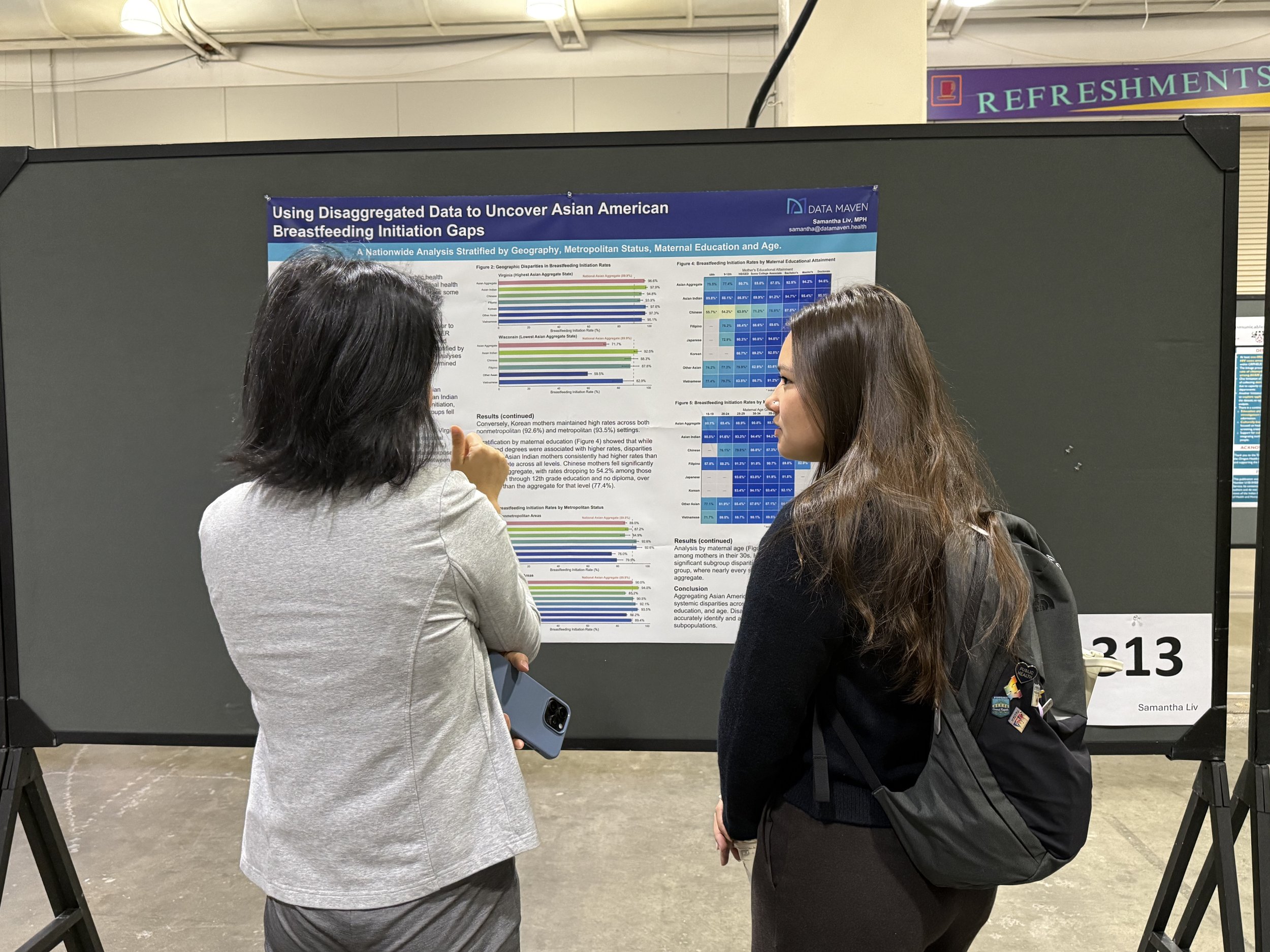
Samantha Liv, MPH, shares her findings with an attendee at the 2026 CSTE conference.
Why Breastfeeding Is Important
Both the American Academy of Pediatrics and the World Health Organization recommend exclusive breastfeeding for the first six months of life because it reduces the risk of infant mortality, sudden infant death syndrome (SIDS), asthma,Type 1 diabetes, and obesity, while lowering the mother's risk of breast and ovarian cancers, high blood pressure, and Type 2 diabetes. In addition to health care-related challenges, social and cultural factors — like limited social support, lack of paid maternity leave, public shaming, and racism — prevent many women from starting or continuing to breastfeed.
How Aggregate Data Hides Disparities
Asian American health outcomes are often reported using broad, aggregated racial categories. The National Center for Health Statistics collects data on Asian Indian, Chinese, Filipino, Japanese, Korean, Vietnamese, and Other Asian populations and combines them under one Asian aggregate category. Unfortunately, the statistical success of certain groups frequently obscures significant health disparities among others, creating blind spots that prevent targeted interventions.
What the 2024 Data Shows
Looking at 2024 aggregated data, Asian Americans appeared to have a significantly better breastfeeding initiation rate than the national average in the United States. However, a look at the disaggregated data revealed wide disparities: Breastfeeding initiation rates among Asian Indian (93.9%), Korean (93.5%), Japanese (92.3%), and Filipino (90.6%) mothers were higher than the Asian aggregate. Meanwhile, Vietnamese (89.1%), Other Asian (85.9%), and Chinese (85.3%) mothers had significantly lower initiation rates than the Asian aggregate.
When we stratified these results by maternal education, state geography, metropolitan status, and age, the masking effect became even more apparent.
Disparities by Education. While advanced degrees were associated with higher rates of breastfeeding initiation, disparities persisted. Asian Indian mothers consistently had higher rates than the aggregate across all levels of education. Chinese mothers fell significantly below the aggregate, with rates dropping to 54.2% among those with a ninth through 12th grade education and no diploma — 23% less than the aggregate rate for that education level (77.4%).
Disparities by State. In Virginia, the state with the highest initiation rate, all subgroups exceeded the national aggregate, led by Asian Indian mothers (97.7%) and Korean mothers (97.6%). Disparities were exposed in Wisconsin, the state with the lowest rate, where we found a severe 33-point gap between the breastfeeding initiation rates of Asian Indian mothers (92.5%) and Other Asian mothers (59.5%).
Disparities by Metropolitan Status. Vietnamese (79.5%) and Other Asian (76.0%) mothers living in nonmetropolitan areas had notably lower rates than their metropolitan counterparts (86.2% and 89.4%, respectively). Conversely, Korean mothers maintained high rates across both nonmetropolitan (92.6%) and metropolitan (93.5%) settings.
Disparities by Age. Breastfeeding initiation peaked among mothers in their 30s. However, the aggregate baseline hid significant disparities, particularly within the 25–29 age group, where nearly every Asian subgroup was either significantly higher or significantly lower than the aggregate.
What This Means for Public Health Practice
Our research concluded that racial aggregates actively obscure significant breastfeeding initiation gaps among Chinese, Vietnamese, and Other Asian subgroups, and particularly among rural residents and those with lower educational attainment. To better identify and serve vulnerable communities currently hidden by racial averages, public health systems must implement disaggregated racial and ethnic data reporting.
We share this research in recognition of National Breastfeeding Month, celebrated each August to promote advocacy, outreach, and the policy and practice changes needed to support babies and families. True support and advocacy, however, require precise data.
To meet the Healthy People 2030 objective of increasing exclusive breastfeeding, we must pair proven interventions — such as the Baby-Friendly Hospital Initiative, peer counseling, and doula care — with the precise, disaggregated data required to deploy them where they are needed most.
Data Maven is a women-owned public health consulting firm with nearly 20 years of experience turning complex datasets into clear, actionable insights, tailored reports, health indices, and custom health tools. Whether you’re a public agency, nonprofit, foundation, or research team, let us bring our analytic expertise to your next project.
-
American Academy of Pediatrics. “Breastfeeding.” Updated February 13, 2026. https://www.aap.org/en/patient-care/newborn-infant-and-early-childhood-nutrition/newborn-and-infant-breastfeeding/.
Baby-Friendly USA. “10 Steps & International Code.” Accessed August 6, 2026. https://babyfriendlyusa.org/10-steps-and-international-code/.
Centers for Disease Control and Prevention. “Breastfeeding Benefits Both Baby and Mom.” Updated July 30, 2026. https://www.cdc.gov/breastfeeding/features/breastfeeding-benefits.html.
Etsey, Meghan, Rhea Manohar, and Brianna Clark on behalf of AMWA Gender Equity Task Force. “Nourishing Without Judgment: Navigating the Stigma Around Breastfeeding and Bottle Feeding.” American Medical Women’s Association, August 19, 2025. https://amwa-doc.org/nourishing-without-judgment-navigating-the-stigma-around-breastfeeding-and-bottle-feeding/.
Healthy People 2030. “Increase the Proportion of Infants Who Are Breastfed Exclusively Through Age 6 Months — MICH‑15.” Objective. Accessed August 6, 2026. https://odphp.health.gov/healthypeople/objectives-and-data/browse-objectives/infants/increase-proportion-infants-who-are-breastfed-exclusively-through-age-6-months-mich-15.
Interrante, Julia D., Alyssa H. Fritz, Marcia B. McCoy, and Katy Backes Kozhimannil. “Effects of Breastfeeding Peer Counseling on County-Level Breastfeeding Rates Among WIC Participants in Greater Minnesota.” Women’s Health Issues 34, no. 3 (2024): 232–40. https://doi.org/10.1016/j.whi.2023.12.001.
Johnson, Kay, Hoda Shawky, and David Willis. Community-Based Doulas and Early Relational Health: The Role of Public Policy and Financing. Nurture Connection, 2024. https://nurtureconnection.org/resource/community-based-doulas-policy/.
Kim, Tae Hyeon, Hyeri Lee, Selin Woo, et al. “Prenatal and Postnatal Factors Associated With Sudden Infant Death Syndrome: An Umbrella Review of Meta-Analyses.” World Journal of Pediatrics 20, no. 5 (2024): 451–60. https://doi.org/10.1007/s12519-024-00806-1.
Li, Ruowei, Julie Ware, Aimin Chen, et al. “Breastfeeding and Post-Perinatal Infant Deaths in the United States, A National Prospective Cohort Analysis.” The Lancet Regional Health – Americas 5 (January 2022). https://doi.org/10.1016/j.lana.2021.100094.
Mantzorou, Maria, Dimitrios Papandreou, Georgios K. Vasios, et al. “Exclusive Breastfeeding for at Least Four Months Is Associated With a Lower Prevalence of Overweight and Obesity in Mothers and Their Children After 2–5 Years From Delivery.” Nutrients 14, no. 17 (2022): 3599. https://doi.org/10.3390/nu14173599.
Moret-Tatay, Amparo, Marcelino Pérez-Bermejo, Adalberto Asins-Cubells, Carmen Moret-Tatay, and María Teresa Murillo-Llorente. “A Systematic Review of Multifactorial Barriers Related to Breastfeeding.” Healthcare 13, no. 11 (2025): 1225. https://doi.org/10.3390/healthcare13111225.
Pac, Jessica, Ann Bartel, Christopher Ruhm, and Jane Waldfogel. “Paid Family Leave and Parental Investments in Infant Health: Evidence from California.” Economics & Human Biology 51 (December 2023): 101308. https://doi.org/10.1016/j.ehb.2023.101308.
Robinson, Karen, Alissa Fial, and Lisa Hanson. “Racism, Bias, and Discrimination as Modifiable Barriers to Breastfeeding for African American Women: A Scoping Review of the Literature.” Journal of Midwifery & Women’s Health 64, no. 6 (2019): 734–42. https://doi.org/10.1111/jmwh.13058.
Wilson, Keadrea, Tebeb Gebretsadik, Margaret A. Adgent, et al. “The Association Between Duration of Breastfeeding and Childhood Asthma Outcomes.” Annals of Allergy, Asthma & Immunology 129, no. 2 (2022): 205–11. https://doi.org/10.1016/j.anai.2022.04.034.
World Health Organization. “Breastfeeding: Recommendations.” Accessed August 6, 2026. https://www.who.int/health-topics/breastfeeding.
