

- November 24, 2026
Explore insights from our analysis of school engagement among teens with depression and anxiety, and the effects adult mentorship can have on their well-being.
Adolescent mental health challenges in the United States are on the rise. According to data from the 2023–2024 National Survey of Children’s Health (NSCH), roughly 30% of adolescents ages 12–17 in the U.S. have a behavioral, developmental, emotional, or mental condition. Anxiety and depression are the most common mental health conditions among adolescents in the U.S.
Anxiety, which affects 11.3% of children, can cause persistent feelings of nervousness, fear, or panic that are difficult to control and can interfere with daily life. Anxiety in adolescents can be costly to treat and impact the productivity of their caregivers. A 2024 study found that adolescents with anxiety had significantly lower quality of life and daily functioning at home and in school compared with those who did not have anxiety.
Depression affects 4.2% of children and can present with symptoms like hopelessness, guilt, low self-esteem, and loss of interest in family, friends, and usual activities. Depression can impede social and emotional development in children and increase the risk of suicide. The effects of childhood mental health challenges can last into adulthood and lead to difficulty completing education, maintaining relationships, and gaining or keeping employment.
As rates of mental health conditions rise among adolescents, many communities are turning to initiatives outside the classroom, such as adult mentorship programs. A 2025 study in Ireland found that a community-based adult mentoring model benefited adolescents who utilize mental health services by increasing confidence, improving social skills and increasing independence. A 2024 study in Australia found that having a sense of belonging in school decreased rates of long-term mental health problems into adulthood. Various mentorship-focused programs report positive impacts on adolescent mental health symptoms and improved academic outcomes.
This fall, our intern Alana Pastula combined her professional background in education with her public health training to analyze the relationship between adult mentorship and school engagement among adolescents with and without anxiety and depression. While anxiety and depression are frequently diagnosed together, this analysis looked at them separately to see if mentorship effects differed. Prevalence estimates were calculated for anxiety and depression among adolescents ages 12–17 by school engagement and adult mentorship using the 2023–2024 NSCH data. NSCH defines an adult mentor as an adult in a child’s school, neighborhood, or community but outside their household who knows the child well and whom the child can rely on for advice and guidance. School engagement, defined as how often the adolescent cares about doing well in school, was used to see if adult mentorship aided adolescents with current anxiety or depression.
School Engagement
Adolescent engagement in school was measured based on caregivers’ responses to two questions: “How often does this child care about doing well in school?” and “How often does this child do all required homework?” with response options of “always,” “usually,” “sometimes,” and “never.” Adolescents were considered engaged in school if their caregiver responded “always” or “usually” to both questions.
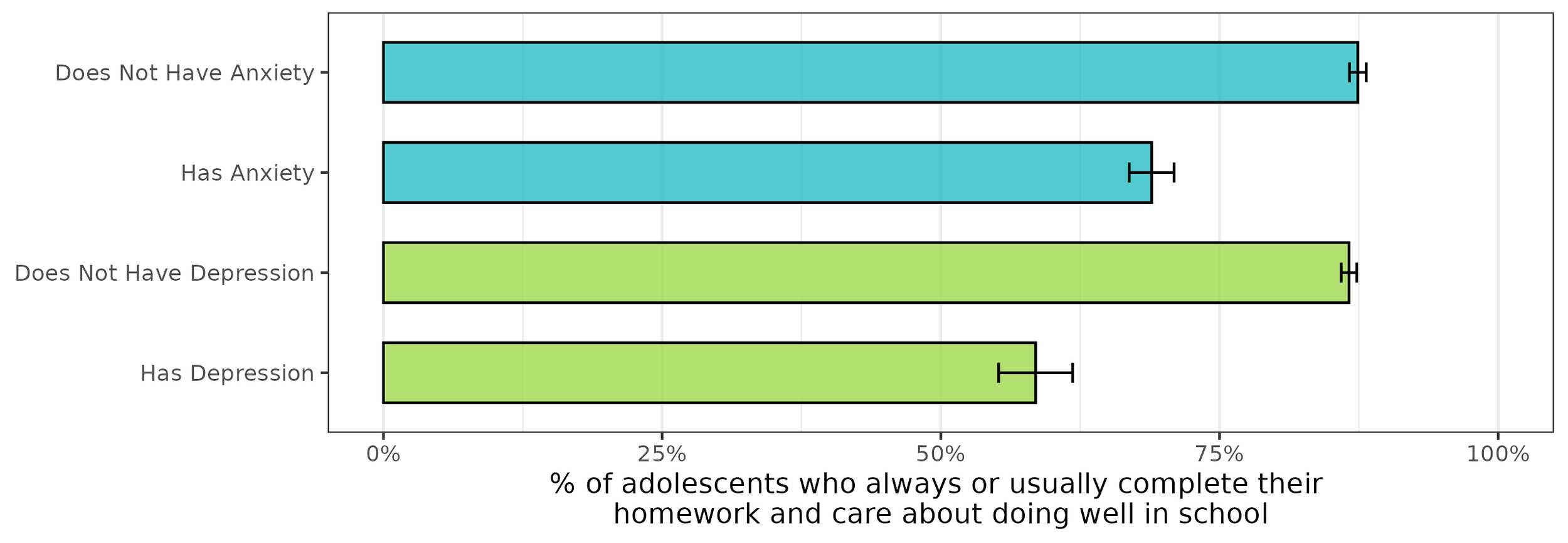
Results indicate that school engagement was higher among adolescents who did not have anxiety (87.4% always/usually completed their homework and cared about doing well in school) and adolescents who did not have depression (86.6%) compared with those with current anxiety (68.9%) and those with current depression (58.5%). Adolescents with depression had the lowest prevalence of always/usually caring about school.
Figure 1. Prevalence of School Engagement Among Adolescents Ages 12–17, by Mental Health Condition, 2023–2024
Source: U.S. Department of Health and Human Services, Health Resources and Services Administration, Maternal and Child Health Bureau, National Survey of Children's Health, 2023–2024.
Table 1. Prevalence of School Engagement Among Adolescents Ages 12–17, by Mental Health Condition, 2023–2024
| Mental Health Condition | Prevalence | 95% CI |
|---|---|---|
| Does not have anxiety | 87.4% | 86.7% – 88.2% |
| Has anxiety | 68.9% | 66.9% – 70.9% |
| Does not have depression | 86.6% | 85.9% – 87.3% |
| Has depression | 58.5% | 55.2% – 61.8% |
Adult Mentorship
The prevalence of adolescents with and without current anxiety or depression who had an adult mentor was based on caregivers’ responses to the question, “Other than you or other adults in your home, is there at least one other adult in this child's school, neighborhood, or community who knows this child well and who they can rely on for advice or guidance?” Responses of “yes” were recorded as having an adult mentor.
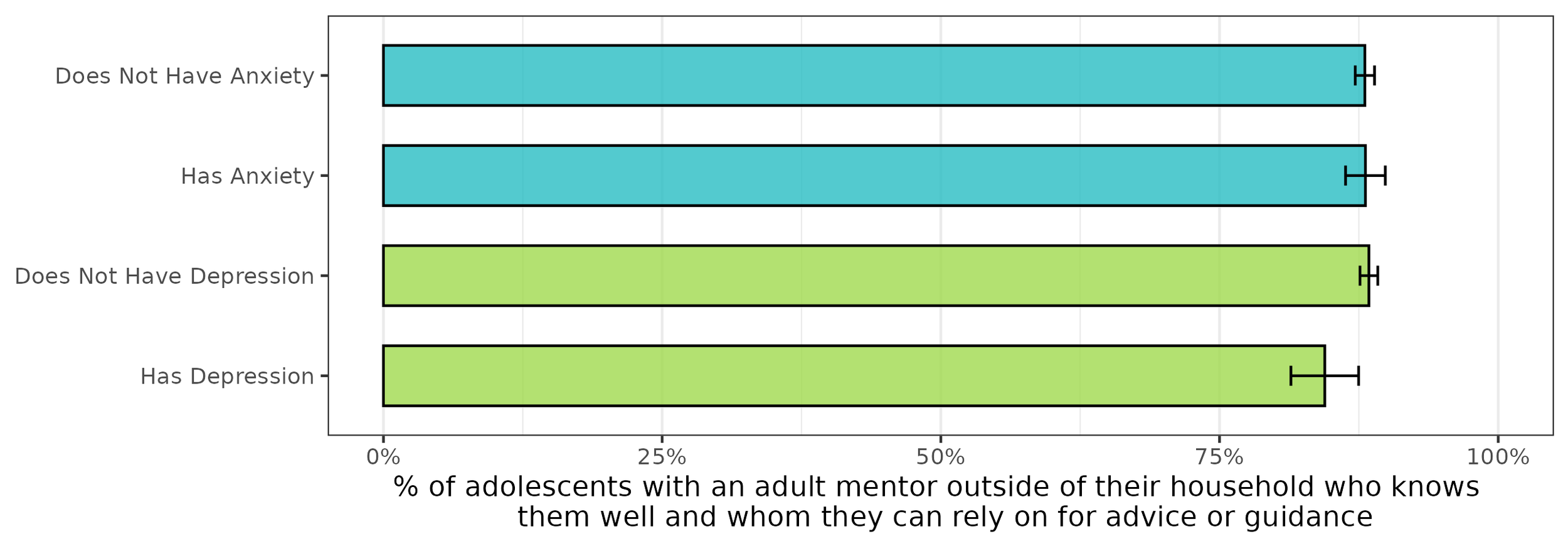
Results indicated that most adolescents, regardless of mental health condition, had some type of adult mentor outside of the home in 2023–2024, with all estimates higher than 80%. The prevalence of adult mentorship was similar among adolescents with current anxiety (88.1%) and those without anxiety (88.0%). However, those with current depression had a significantly lower prevalence of mentorship (84.4%) compared with those without depression (88.4%).
Figure 2. Prevalence of Adult Mentorship Among Adolescents Ages 12–17, by Mental Health Condition, 2023–2024
Source: U.S. Department of Health and Human Services, Health Resources and Services Administration, Maternal and Child Health Bureau, National Survey of Children's Health, 2023–2024.
Table 2. Prevalence of Adult Mentorship Among Adolescents Ages 12–17, by Mental Health Condition, 2023–2024
| Mental Health Condition | Prevalence | 95% CI |
|---|---|---|
| Does not have anxiety | 88.0% | 87.2% – 88.9% |
| Has anxiety | 88.1% | 86.3% – 89.9% |
| Does not have depression | 88.4% | 87.6% – 89.2% |
| Has depression | 84.4% | 81.4% – 87.5% |
Relationship Between Adult Mentorship and School Engagement
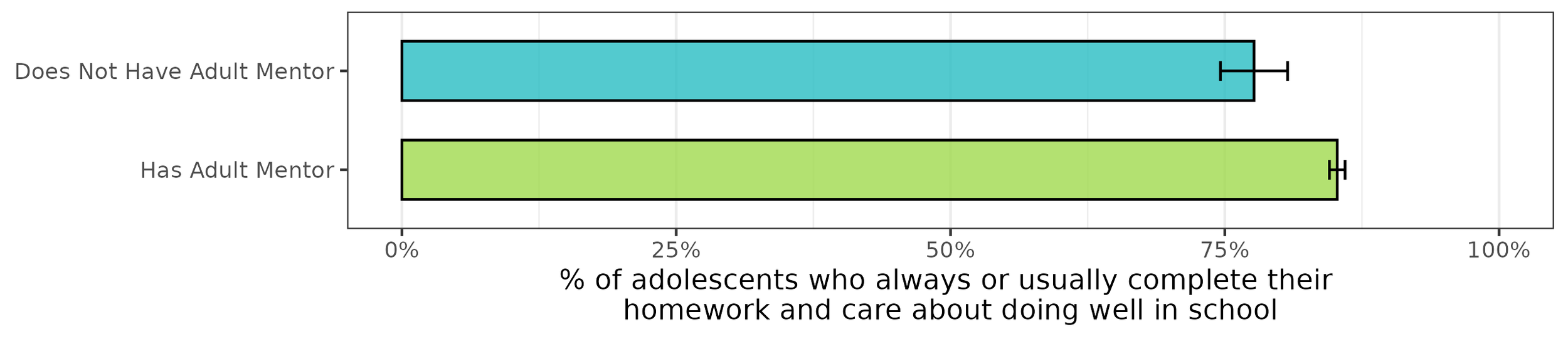
To examine the relationship between adult mentorship and school engagement, we analyzed the prevalence of school engagement among adolescents with and without an adult mentor. Adolescents with a mentor had a higher prevalence of school engagement (85.2% always/usually completed their homework and cared about doing well in school) than those without a mentor (77.7%).
Figure 3. Prevalence of School Engagement Among Adolescents Ages 12–17, by Adult Mentorship, 2023–2024
Source: U.S. Department of Health and Human Services, Health Resources and Services Administration, Maternal and Child Health Bureau, National Survey of Children's Health, 2023–2024.
Table 3. Prevalence of School Engagement Among Adolescents Ages 12–17, by Adult Mentorship, 2023–2024
| Adult Mentor Status | Prevalence | 95% CI |
|---|---|---|
| Does not have adult mentor | 77.7% | 74.6% – 80.7% |
| Has adult mentor | 85.2% | 84.5% – 86.0% |
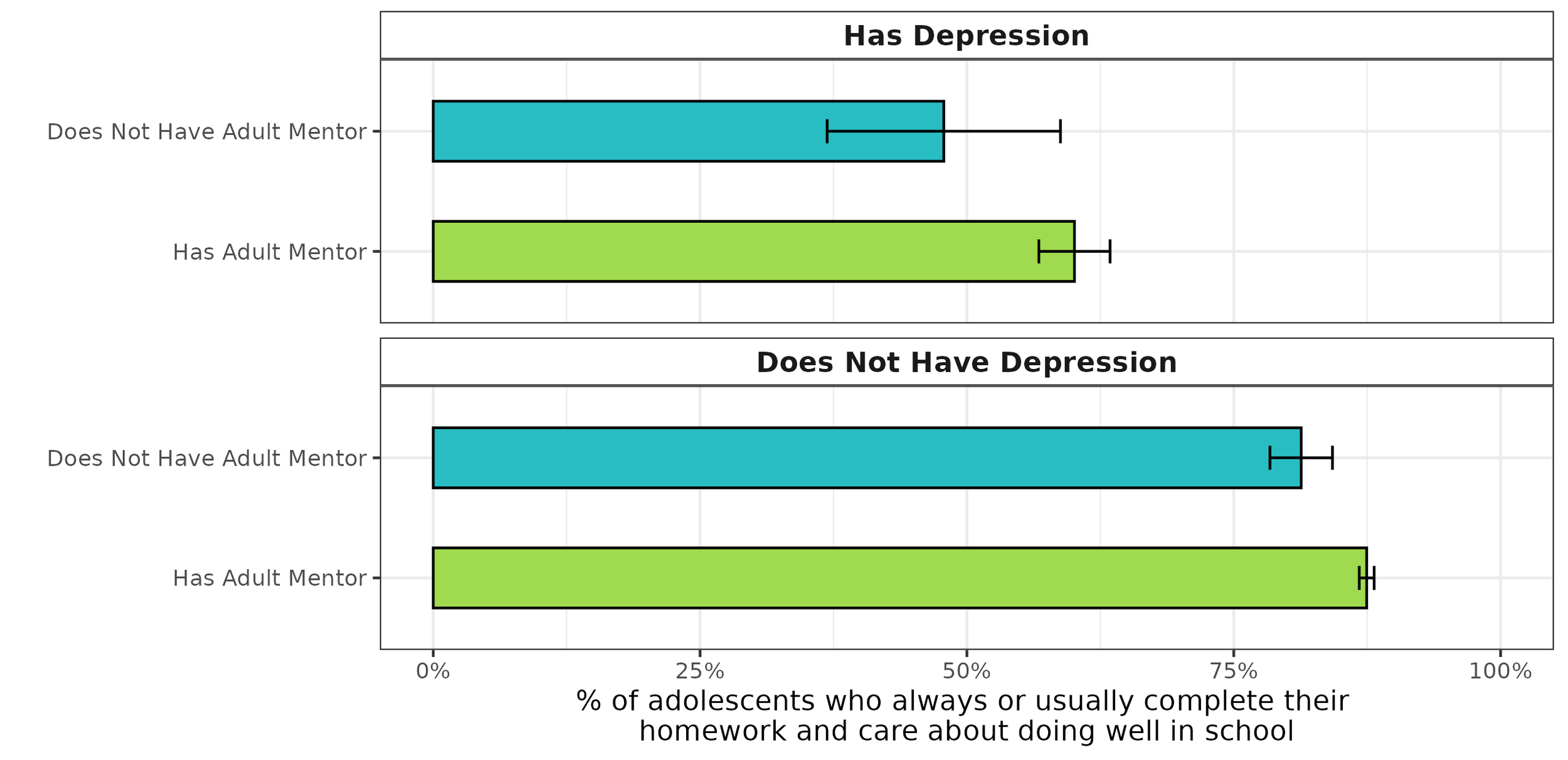
The positive association between adult mentorship and school engagement held true for adolescents without depression, who had higher school engagement if they had an adult mentor (87.5% always/usually completed their homework and cared about doing well in school) than if they had no adult mentor (81.3%). However, adult mentorship did not make a significant difference for adolescents with depression.
Figure 4. Prevalence of School Engagement Among Adolescents Ages 12–17 With and Without Depression, by Adult Mentorship, 2023–2024
Source: U.S. Department of Health and Human Services, Health Resources and Services Administration, Maternal and Child Health Bureau, National Survey of Children's Health, 2023–2024.
Table 4. Prevalence of School Engagement Among Adolescents Ages 12–17 With and Without Depression, by Adult Mentorship, 2023–2024
| Adult Mentor Status | Prevalence | 95% CI | |
|---|---|---|---|
| Has depression | |||
| Does not have adult mentor | 47.8% | 36.9% – 58.8% | |
| Has adult mentor | 60.0% | 56.7% – 63.4% | |
| Does not have depression | |||
| Does not have adult mentor | 81.3% | 78.4% – 84.2% | |
| Has adult mentor | 87.5% | 86.8% – 88.2% | |
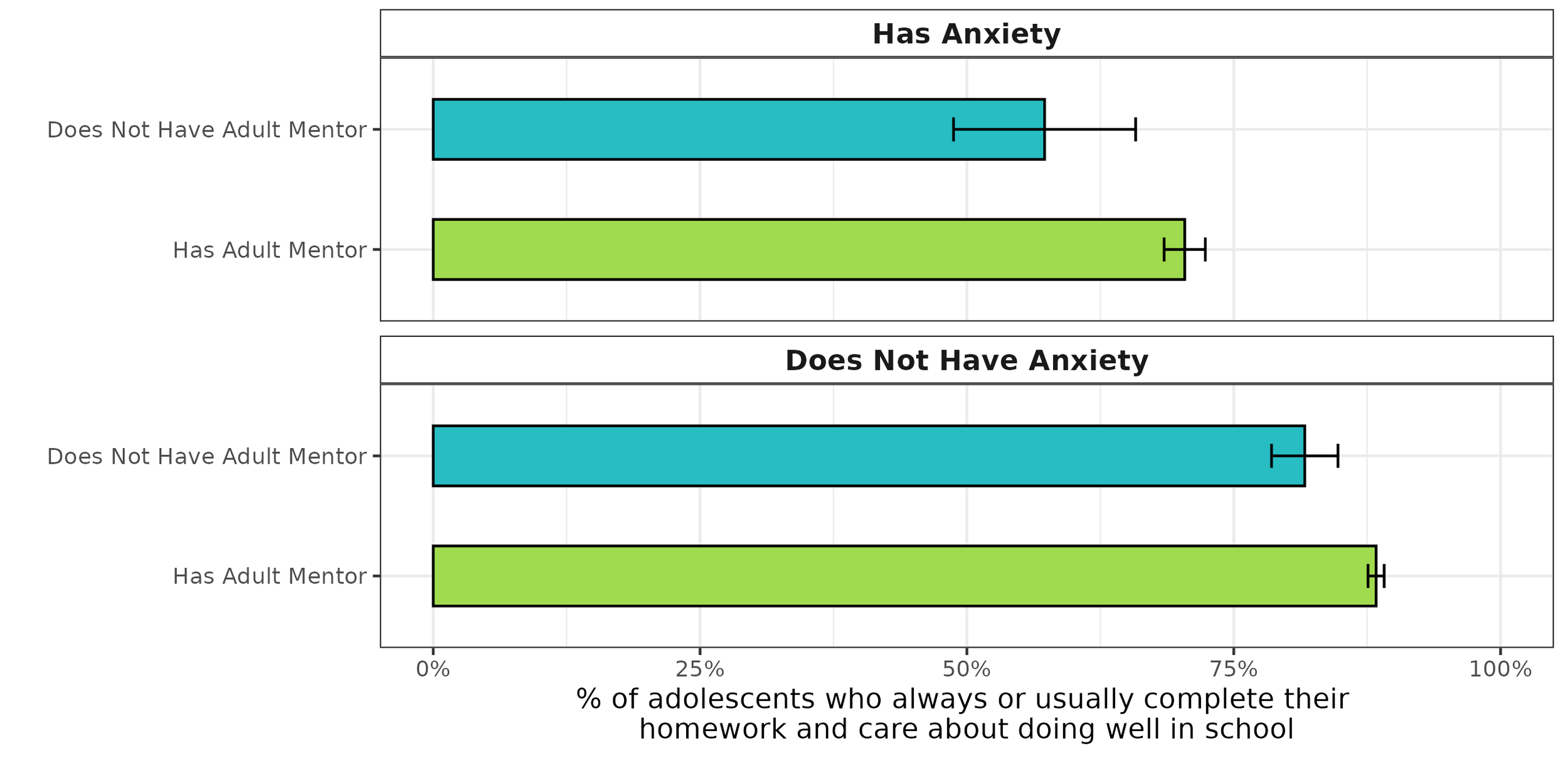
The positive association with adult mentorship continued among adolescents with anxiety, who had higher school engagement with an adult mentor (88.3% always/usually completed their homework and cared about doing well in school) than those without a mentor (81.7%). Similarly, adolescents with anxiety who had a mentor showed higher school engagement (70.4%) than those without a mentor (57.3%).
Figure 5. Prevalence of School Engagement Among Adolescents Ages 12–17 With and Without Anxiety, by Adult Mentorship, 2023–2024
Source: U.S. Department of Health and Human Services, Health Resources and Services Administration, Maternal and Child Health Bureau, National Survey of Children's Health, 2023–2024.
Table 5. Prevalence of School Engagement Among Adolescents Ages 12–17 With and Without Anxiety, by Adult Mentorship, 2023–2024
| Adult Mentor Status | Prevalence | 95% CI | |
|---|---|---|---|
| Has anxiety | |||
| Does not have adult mentor | 57.3% | 48.7% – 65.8% | |
| Has adult mentor | 70.4% | 68.5% – 72.3% | |
| Does not have anxiety | |||
| Does not have adult mentor | 81.7% | 78.5% – 84.8% | |
| Has adult mentor | 88.3% | 87.6% – 89.1% | |
Conclusions
A limitation of this data is that it is only a snapshot of interacting variables at a single point in time, and may not fully capture how the introduction of adult mentorship may influence an adolescent’s thoughts or behaviors over time. However, results from our analysis show a significant positive relationship between having an adult mentor and higher school engagement among most groups, with the exception of adolescents with depression. Studies show that having a trusted adult outside the family unit positively affects adolescent self-esteem and physical health. Mental health outcomes also improve with an adult mentor.
Each child is unique and has different needs. Those with anxiety and/or depression may need to try different support systems in order to get the help they need. Providing opportunities for bettering overall health is the top priority this month and every month.
-
2023-2024 National Survey of Children’s Health. Child and Adolescent Health Measurement Initiative. U.S. Department of Health and Human Services, Health Resources and Services Administration, Maternal and Child Health Bureau. Accessed October 17, 2026. https://www.childhealthdata.org/browse/survey.
“Does This Child Currently Have Anxiety Problems, Age 3-17 Years?” https://www.childhealthdata.org/browse/survey/results?q=11887&r=1.
“Does This Child Currently Have Depression, Age 3-17 Years?” https://www.childhealthdata.org/browse/survey/results?q=11888&r=1.
“Indicator 2.10: Does This Child Have a Mental, Emotional, Developmental or Behavioral (MEDB) Problem, Age 3-17 Years?” https://www.childhealthdata.org/browse/survey/results?q=11968&r=1&g=1282.
“Indicator 5.2: How Often Does This Child Engage in School: Cares about Doing Well in School and Does Required Homework, Age 6-17 Years?” https://nschdata.org/browse/survey/results?q=12067&r=1.
“National Performance Measure: Percent of Adolescents, Ages 12 through 17 Years, Who Have One or More Adults Outside the Home Who They Can Rely on for Advice or Guidance.” https://www.nschdata.org/browse/survey/results?q=12153&r=1.
Allen, Kelly-Ann, Christopher J. Greenwood, Emily Berger, Lefteris Patlamazoglou, Andrea Reupert, Gerald Wurf, Fiona May, et al. “Adolescent School Belonging and Mental Health Outcomes in Young Adulthood: Findings from a Multi-Wave Prospective Cohort Study.” School Mental Health 16 (March 1, 2024): 149–60. https://doi.org/10.1007/s12310-023-09626-6.
Beirão, Diogo, Helena Monte, Marta Amaral, Alice Longras, Carla Matos, and Francisca Villas-Boas. “Depression in Adolescence: A Review.” Middle East Current Psychiatry 27, no. 1 (October 2, 2020): 50. https://doi.org/10.1186/s43045-020-00050-z.
Centers for Disease Control and Prevention. “Data and Statistics on Children’s Mental Health.” CDC.gov, August 20, 2026. Accessed November 18, 2026. https://www.cdc.gov/children-mental-health/data-research/index.html.
Clayborne, Zahra M., Melanie Varin, and Ian Colman. “Systematic Review and Meta-Analysis: Adolescent Depression and Long-Term Psychosocial Outcomes.” Journal of the American Academy of Child & Adolescent Psychiatry 58, no. 1 (January 1, 2019): 72–79. https://doi.org/10.1016/j.jaac.2018.07.896.
Dickson, Sophie J., Ella L. Oar, Maria Kangas, Carly J. Johnco, Cassie H. Lavell, Ashleigh H. Seaton, Lauren F. McLellan, Viviana M. Wuthrich, and Ronald M. Rapee. “A Systematic Review and Meta-Analysis of Impairment and Quality of Life in Children and Adolescents with Anxiety Disorders.” Clinical Child and Family Psychology Review 27, no. 2 (June 1, 2024): 342–56. https://doi.org/10.1007/s10567-024-00484-5.
Kalin, Ned H. “The Critical Relationship Between Anxiety and Depression.” American Journal of Psychiatry 177, no. 5 (May 2020): 365–67. https://doi.org/10.1176/appi.ajp.2020.20030305.
Mayo Clinic Staff. “Anxiety Disorders: Symptoms and Causes.” Mayo Clinic, July 29, 2025. Accessed November 18, 2026. https://www.mayoclinic.org/diseases-conditions/anxiety/symptoms-causes/syc-20350961.
Mayo Clinic Staff. “Teen Depression: Symptoms and Causes.” Mayo Clinic, August 12, 2022. Accessed November 18, 2026. https://www.mayoclinic.org/diseases-conditions/teen-depression/symptoms-causes/syc-20350985.
Mentoring & Mental Health. MENTOR, December 2021. https://www.mentoring.org/wp-content/uploads/2021/12/Mentoring-and-Mental-Health.pdf.
Rhodes, Jean. “24,000 Adolescents Have Spoken: Mentors Make a Difference in Mental Health.” The Chronicle of Evidence-Based Mentoring (blog), June 24, 2025. Accessed November 18, 2026. https://www.evidencebasedmentoring.org/24000-youth-have-spoken-mentors-make-a-difference-in-mental-health/.
Schwartz, Sarah E. O., Sarah R. Lowe, and Jean E. Rhodes. “Mentoring Relationships and Adolescent Self-Esteem.” The Prevention Researcher 19, no. 2 (April 1, 2012): 17–20. https://pmc.ncbi.nlm.nih.gov/articles/PMC3873158/.
Silke, Charlotte, and Bernadine Brady. “Is Youth Mentoring Beneficial for Child and Adolescent Mental Health Service Users? A Multi-Stakeholder Perspective.” Child & Youth Care Forum 54 (October 1, 2025): 1109–37. https://doi.org/10.1007/s10566-025-09852-w.
Van Dam, L., D. Smit, B. Wildschut, S. J. T. Branje, J. E. Rhodes, M. Assink, and G. J. J. M. Stams. “Does Natural Mentoring Matter? A Multilevel Meta-Analysis on the Association Between Natural Mentoring and Youth Outcomes.” American Journal of Community Psychology 62, no. 1–2 (September 2018): 203–20. https://doi.org/10.1002/ajcp.12248.
The Annie E. Casey Foundation. “Youth Mental Health Statistics in 2024,” July 25, 2025. Accessed November 18, 2026. https://www.aecf.org/blog/youth-mental-health-statistics.
