Maternity Care Deserts and Their Associations With Infant, Child and Maternal Mortality at the State Level
Natasha Kataeva
2023 American Public Health Association (APHA) Annual Meeting and Expo
Background
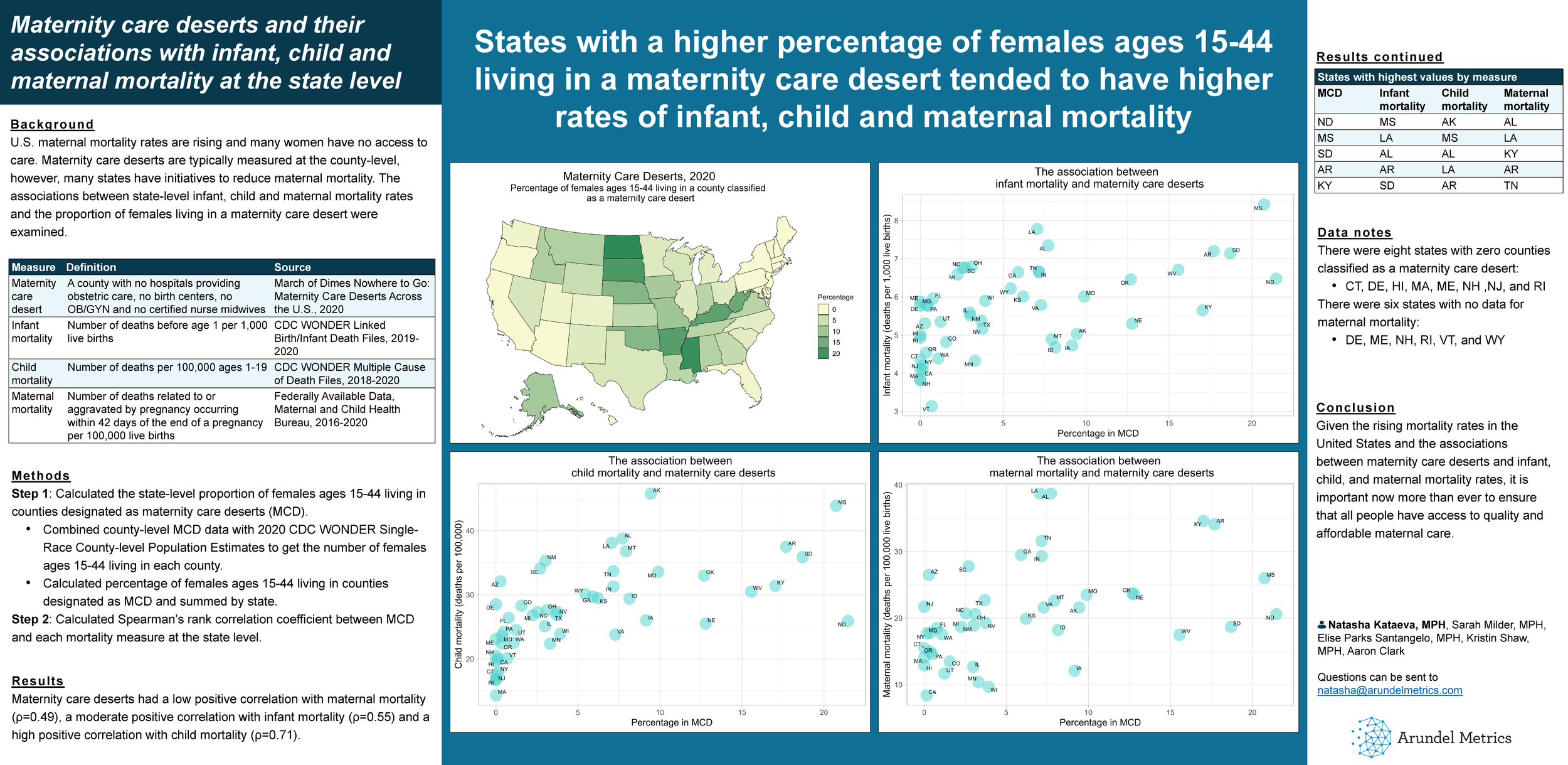
U.S. maternal mortality rates are rising and many women have no access to care. Maternity care deserts are typically measured at the county-level, however, many states have initiatives to reduce maternal mortality. The associations between state-level infant, child and maternal mortality rates and the proportion of females living in a maternity care desert were examined.
Methods
The state-level proportion of females ages 15-44 living in a maternity care desert (county with no hospitals providing obstetric care, no birth centers, no OB/GYN and no certified nurse midwives) was calculated using 2020 March of Dimes and CDC WONDER Single-Race Population Estimates data. State-level children (deaths per 100,000 ages 1-19), infant (deaths before age 1 per 1,000 live births) and maternal (deaths related to or aggravated by pregnancy, excluding accidental or incidental causes occurring within 42 days of the end of a pregnancy per 100,000 live births) mortality rates were calculated from 2018-2020 CDC WONDER, Multiple Cause of Death Files; 2019-2020 Linked Birth/Infant Death Files; and 2016-2020 Federally Available Data, Maternal and Child Health Bureau, respectively.
Results
Maternity care deserts had a low positive correlation with maternal mortality (r=0.49), a moderate positive correlation with infant mortality (r=0.55) and a high positive correlation with child mortality (r=0.71).
Conclusion
States with a higher percentage of females living in maternity care deserts tended to have higher rates of maternal, infant and child mortality. More research is needed to unpack the relationship between maternity care deserts and mortality.