Syphilis Resurgence in the United States (2017-2022): An Analysis of Trends, Geographic Variations and Disparities
Samantha Liv
2024 Council of State and Territorial Epidemiologists (CSTE) Annual Conference • Pittsburgh, PA
Background
The rising incidence of primary, secondary and congenital syphilis across the United States presents significant public health challenges. This study analyzed syphilis cases and rates from 2017 to 2021, aiming to provide an understanding of the temporal trends, geographical variations and population disparities associated with the resurgence in sexually transmitted infections.
Methods
U.S. state-level temporal trends were analyzed from 2017 to 2021 via percent change calculations and geographic variations were assessed for the year 2021. Primary and secondary syphilis rates were analyzed by age, race/ethnicity and sex at the national level. Data was obtained from the CDC NCHHSTP AtlasPlus and analysis was performed using R statistical software.
Results
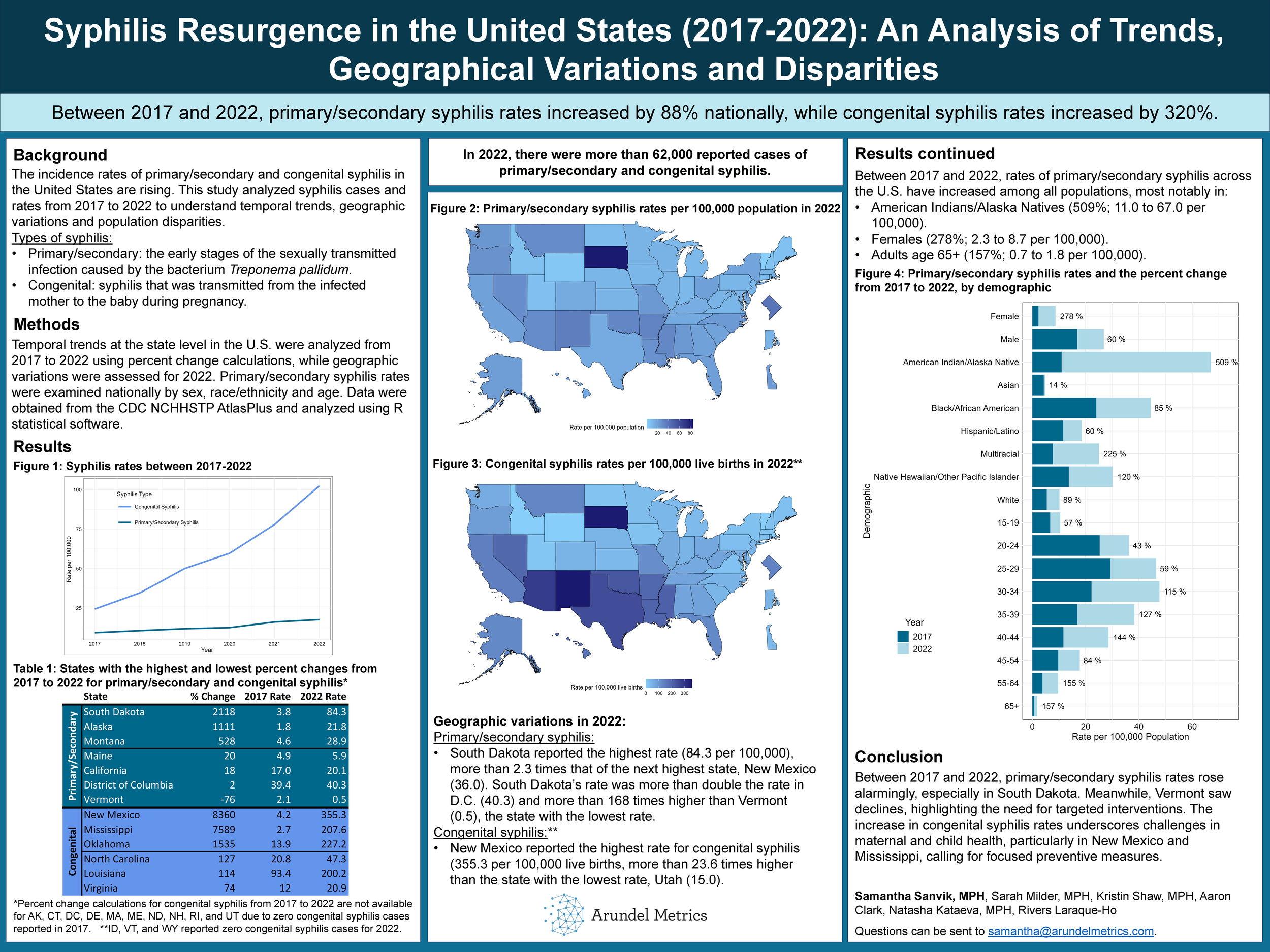
Temporal trends from 2017 to 2021 showed primary and secondary syphilis rate changes across the nation, the highest occurring in Alaska with a 1372% increase (1.8 to 26.5 per 100,000) and a decrease in two states and the District of Columbia (-3%; 39.4 to 38.4 per 100,000): Vermont (-33%; 2.1 to 1.4 per 100,000) and Maine (-10%; 4.9 to 4.4 per 100,000). Congenital syphilis rates increased in nearly all states. The highest increase was in Mississippi (6641%, 2.7 to 182.0 per 100,000) while the lowest increase occurred in Nebraska (5.1%; 3.9 to 4.1 per 100,000).
In 2021, South Dakota reported the highest rate of primary/secondary syphilis (48.7 per 100,000, 436 cases), while Vermont reported the lowest (1.4 per 100,000, 9 cases), highlighting regional variability. For congenital syphilis, Arizona faced the highest rate (232.3 per 100,000, 181 cases), while Maine, New Hampshire, and Wyoming reported zero cases, and Nebraska, Delaware and Vermont each reported 1 case (4.1, 9.5 and 18.6 per 100,000, respectively) in 2021.
Between 2017 and 2021, rates of primary and secondary syphilis across the U.S. have increased in all populations, notably for American Indians/Alaska Natives (325%; 11.0 to 46.7 per 100,000), females (217%; 2.3 to 7.3 per 100,000) and adults ages 65+ (114%; 0.7 to 1.5 per 100,000).
Conclusions
This study highlights syphilis trends in the United States from 2017 to 2021. Alarming increases in primary and secondary syphilis, particularly in Alaska, contrast with declines in Vermont, Maine, and D.C., necessitating targeted interventions. The surge in congenital syphilis, notably in Mississippi, underscores maternal and child health challenges, urging focused preventive measures. These findings emphasize the need for continued surveillance and targeted strategies to mitigate syphilis impact across diverse populations nationwide.