Comparing Multiple Relative Inequality Summary Measure Methods for Data Exploration Across States
Aaron Clark
2026 Behavioral Risk Factor Surveillance System (BRFSS) Annual Meeting
Background
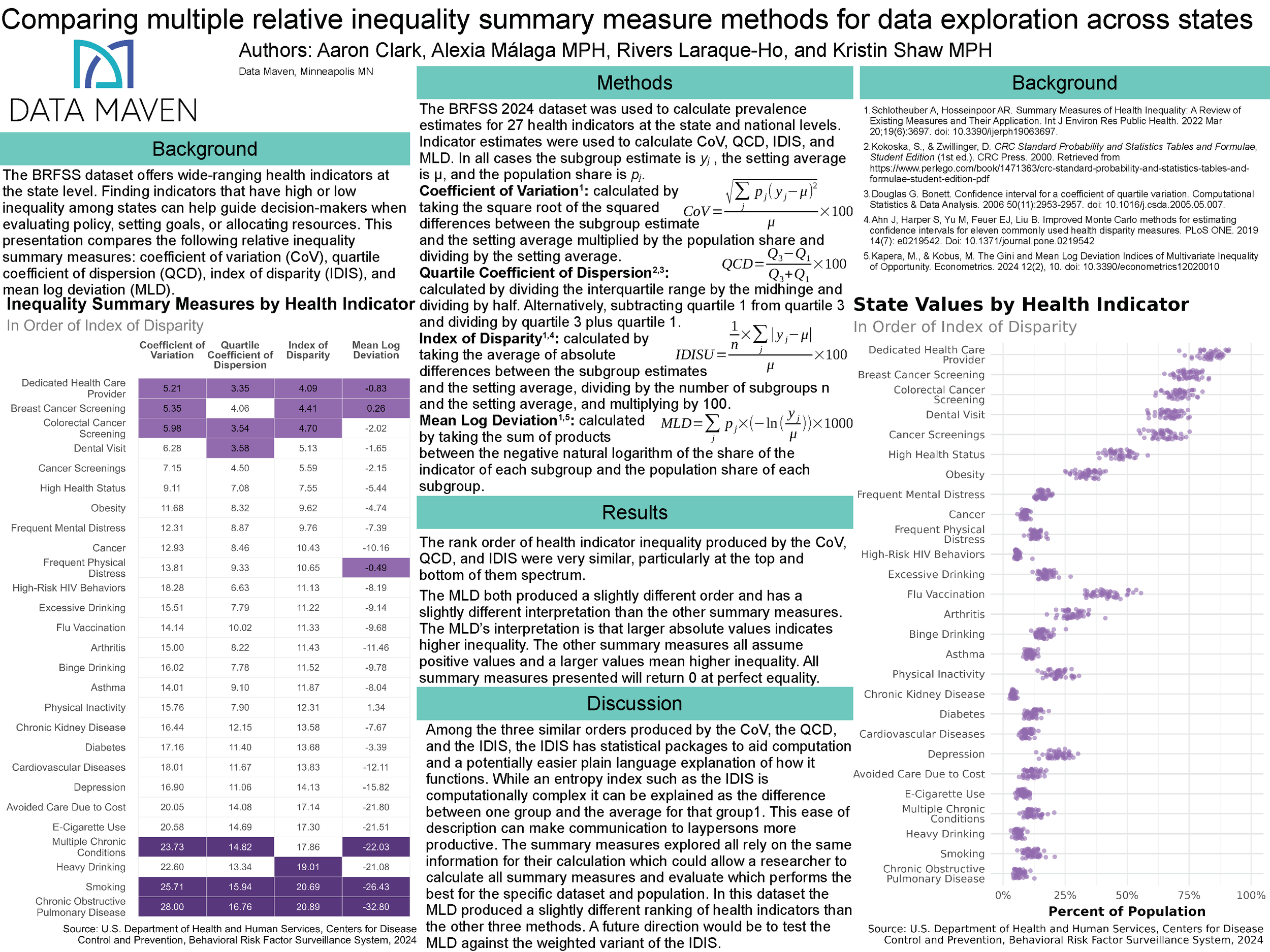
The BRFSS dataset offers wide-ranging health indicators at the state level. Finding indicators that have high or low inequality among states can help guide decision-makers when evaluating policy, setting goals, or allocating resources. This presentation compares the following relative inequality summary measures: coefficient of variation (CoV), quartile coefficient of dispersion (QCD), index of disparity (IDIS), and mean log deviation (MLD).
Objectives
To observe the performance of different relative inequality summary measures on BRFSS estimates and develop guidance.
Methods
The BRFSS 2024 dataset was used to calculate prevalence estimates for 27 health indicators at the state and national levels. Indicator estimates were used to calculate CoV, QCD, IDIS, and MLD. The three highest-inequality and three lowest-inequality indicators identified by each method were selected for comparison, along with three indicators from the midpoint.
Results
The indicators selected using CoV, QCD, IDIS, and MLD were highly similar to each other, with QCD, IDIS, and MLD each having one unique selection among the six indicators with the highest and lowest inequality. Almost all measures from the middle were unique.
Conclusions
CoV, QCD, IDIS, and MLD all performed similarly. This suggests that whichever summary measure is easiest to explain to the intended audience is likely the best choice, as none performed notably better in this sample. Modern computational capabilities also make it possible to perform all four summaries to compare the outcomes.